

COVID-19 Is Gone, But Visual Symptoms Remain
Many people recovered from COVID-19 and believed the illness was completely behind them. But years later, some begin noticing unusual symptoms that are difficult to explain.
Many patients come to our clinic with a quite similar story.

They say things like:
I feel dizzy in crowded places.
Busy environments make me anxious
I feel like my brain is foggy.
It's hard to concentrate when working or reading.
Sometimes the world feels slightly unreal or unstable.
Most of them have already undergone standard medical and eye examinations.
Their eyesight may be normal, and scans often show nothing unusual.
Yet the symptoms continue…
A Pattern We Are Beginning to Notice
At Nakoon Optometry & Vision Therapy, we began noticing something interesting.
A large number of these patients share one thing in common:
They had COVID-19 in the past.
Since the COVID-19 pandemic, many people around the world—not only in Thailand—have reported similar symptoms. This has led researchers to investigate what might be happening.
Studies now show that COVID-19 can affect the brain, not just the lungs.
Some patients develop neurological changes that resemble what we see after mild traumatic brain injury (concussion).
These changes may include:
• inflammation in the brain
• reduced oxygen delivery during illness
• disruption of the blood–brain barrier
• changes in the brain’s micro-circulation
• disruption in areas of the brain responsible for eye coordination and spatial awareness
Because the visual system is closely linked to these brain functions, it is possible that visual coordination may also be affected.

Why Vision Symptoms Can Occur?
Most people think vision is simply about how clearly we see.
But vision is actually about how the brain controls the eyes and processes visual information.
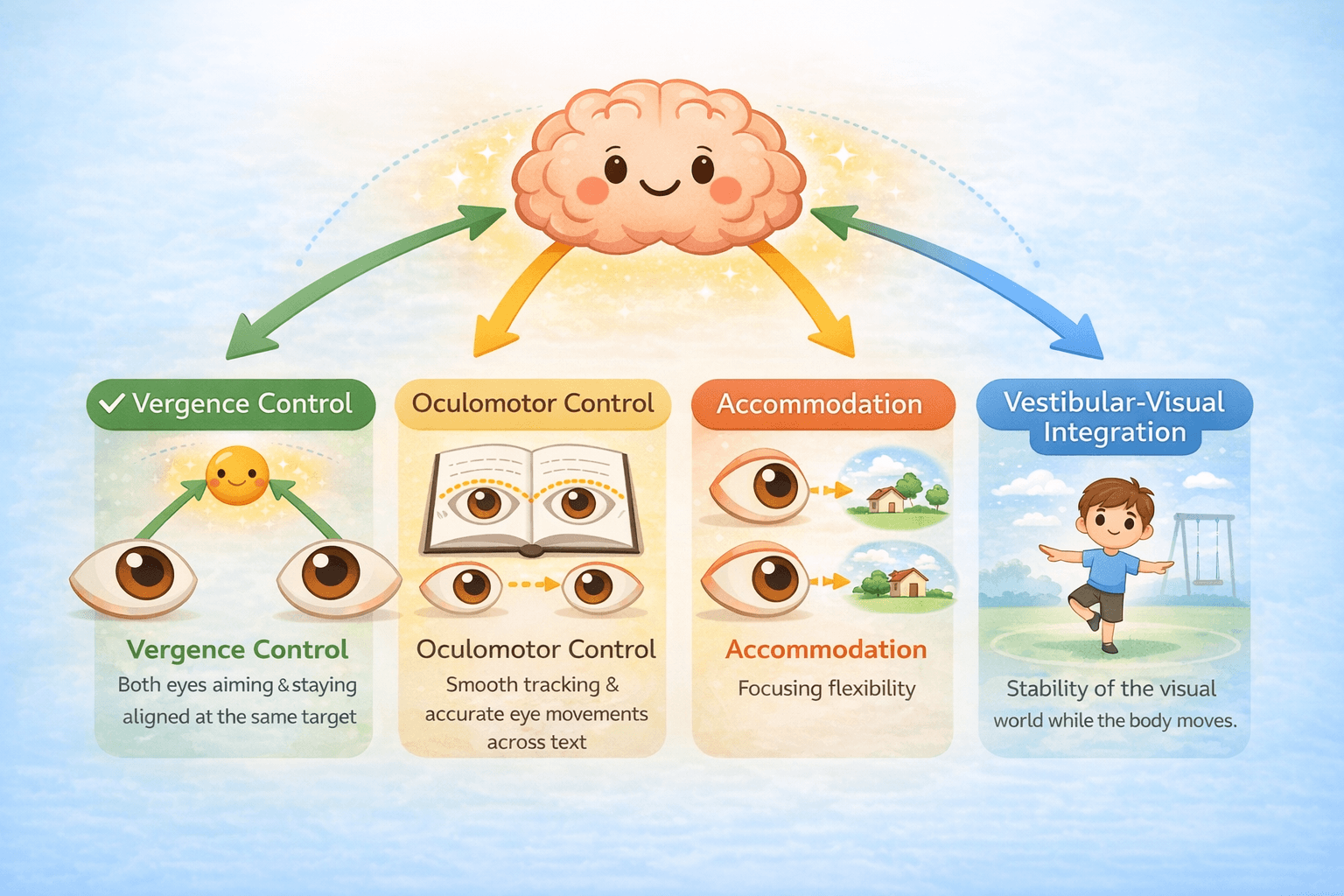
COVID-related brain inflammation can affect several important systems, including:
• Vergence control – how well the two eyes aim and stay aligned at the same target
• Oculomotor control – smooth tracking and accurate eye movements across text
• Accommodation – adjusting focus between distances
• Vestibular-visual integration – how the brain keeps the visual world stable when the body moves
When these systems work well, the world feels stable and effortless.

But when they become disrupted, people may experience symptoms such as:
• dizziness in visually busy environments
• discomfort or anxiety in crowded spaces
• difficulty focusing when reading
• brain fog or mental fatigue
• trouble concentrating for long periods
• motion sensitivity when using screens or scrolling
• a sense that the world feels “off” or slightly unreal
These experiences are not imagined and commonly reported, even when standard tests appear normal.
Why Standard Eye Exams May Not Show the Problem
One reason patients feel confused is that their eyesight is often perfectly normal.
They may have:
• 20/20 vision
• a healthy retina
• normal eye pressure
However, traditional eye exams mainly test visual clarity, not how the eyes and brain work together.
At Nakoon, we evaluate additional visual functions such as:
• binocular coordination (how well the two eyes work as a team)
• eye movement control for reading
• focusing flexibility
• visual-vestibular integration
In many post-COVID patients, we find instability in these systems.
A Balanced Perspective
It is important to emphasize that:
We cannot currently conclude that COVID-19 directly causes binocular vision dysfunction.
However, the pattern observed clinically—both locally and internationally—suggests that there may be a meaningful association in some individuals.
Further research is still needed to fully understand this relationship.
The Good News: These Systems Can Improve

The brain is adaptable.
With the right type of treatment, we can help retrain how the eyes and brain work together.
Depending on the type of binocular dysfunction, treatment may include:
• Specialty lenses
• Prism lenses
• Precision-tinted lenses
• Vision therapy
If Your Symptoms Feel Familiar
If you are experiencing:
• dizziness in supermarkets or crowded places
• brain fog when reading or working
• eye strain or headaches with screens
• difficulty concentrating for long periods
…and you had COVID-19 in the past, it may be worth exploring whether your visual coordination system is contributing to these symptoms.
At Nakoon Optometry & Vision Therapy, we focus on understanding how the eyes and brain work together.
Sometimes, understanding the visual component can provide an important missing piece of the puzzle.